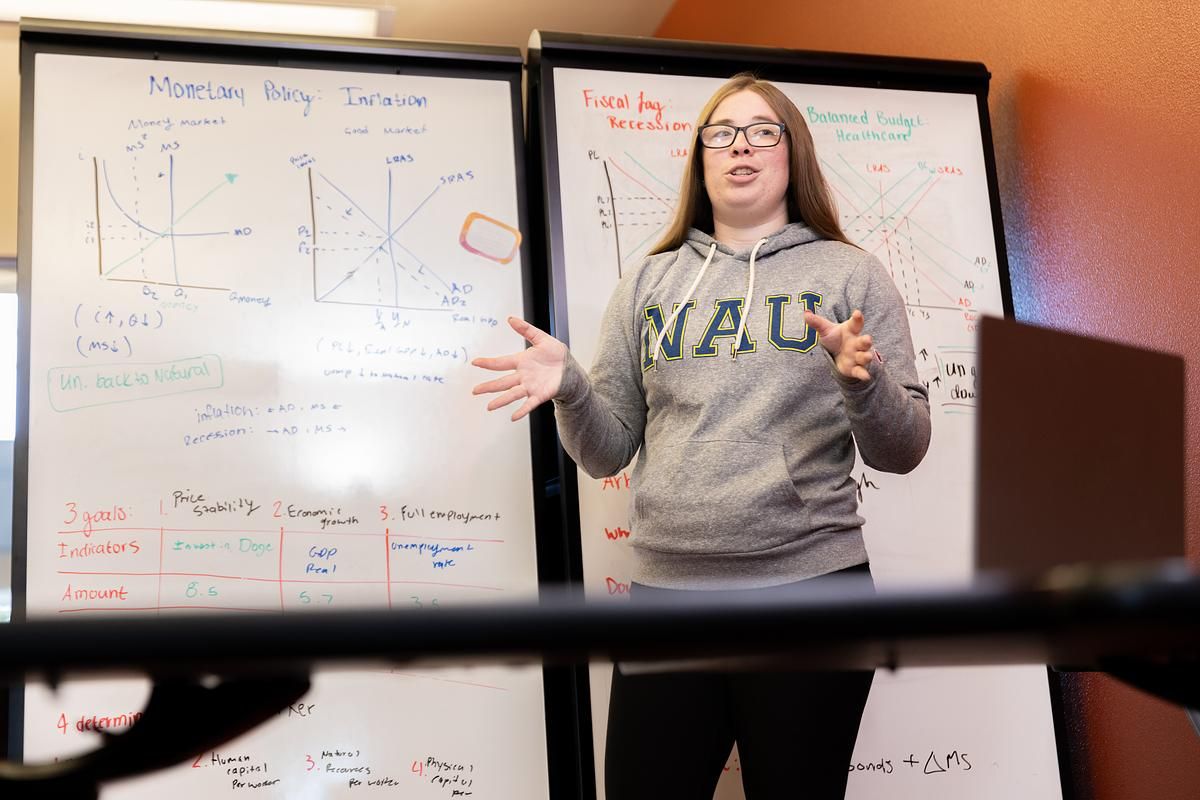
Where numbers drive decisions
Learn how money, markets, and data shape organizations and global systems while earning a degree in Economics, Finance, and Accounting. If you enjoy problem-solving, analyzing trends, weighing risk and reward, or making sense of complex information, these fields offer you a path for translating numbers into vital information.
Why study Economics, Finance, and Accounting at NAU
This isn't a one-size-fits-all business education. At NAU’s W.A. Franke College of Business (FCB), you’ll apply the concepts you learn through student-run investment portfolios, analysis of economic policy, and auditing real financial documents, all the while working with faculty who know you by name.
Accounting students prepare for professional certification with guidance from experienced faculty who understand today’s regulatory and industry demands. Finance students take on real-world responsibility managing an investment fund and making data-driven decisions with real financial stakes. Economics students dive into data, policy, and market behavior, learning how to identify trends and develop solutions for organizations.
With access to Bloomberg terminals, immersive coursework, internships, and collaborative research, you’ll graduate confidently prepared to lead in a data-driven economy.
Learning outcomes
As an Economics, Finance, and Accounting major at NAU, you will:
- analyze financial, business, and tax information and appropriately apply a given measurement and reporting method.
- use analytical techniques to identify a business problem, generate and compare alternatives, and develop a solution.
- use supply and demand concepts to determine market equilibrium.
- determine the optimal amount of labor to hire to achieve an efficient outcome in the labor market.
- forecast an income statement, balance sheet, and cash flow statement using appropriate inputs such as receivables, contracts, and market values.
- identify and explain the causes of risk, how to measure and price risk, and how to assess the effects of risk in decision making.
Student clubs and organizations
Connect what you’re learning in the classroom to professional development and networking by joining a club or organization.
Clubs
- Distributive Education Clubs of America (DECA)
- Future Business Women of America
- Gamma Iota Sigma (GIS)
- NAU Investment Club
- Alpha Kappa Psi (coed fraternity)
- Beta Alpha Psi
- Beta Gamma Sigma (honor society)
- Delta Sigma Pi
Student-managed investment fund
Apply what you’re learning by investing in real markets as part of a student-managed investment fund. You’ll conduct in-depth equity research, evaluate risk, and manage a portfolio valued at more than $1.8 million.
Dedicated support
At NAU, you'll find support that scales with you. Small class sizes, accessible faculty, and plentiful scholarships provide a tailored experience at every stage of working toward achieving your goals.
Faculty mentorship
You'll learn from faculty who combine academic knowledge with industry perspective. With mentorship and opportunities for collaborative research, you’ll receive individualized support as you turn theory into practice and grow professionally.
Scholarships and financial aid
The W.A. Franke College of Business is dedicated to investing in your future with you. More than $700,000 was awarded in scholarships during the 2023-24 academic year thanks to the generosity of alumni and donors. Scholarships may be specific to academic achievement, involvement, financial need, or major. Browse Scholarship Universe for FCB-sponsored scholarships specific to your interests and major.
Career readiness
Leave the W.A. Franke College of Business not just job ready, but future ready. From financial analysts and economists to auditors and consultants, students develop critical thinking, data fluency, and decision-making skills that translate across industries. Through applied coursework, real-world projects, internships, and experiential learning, you’ll be ready to turn analysis into action in fast-moving, data-driven environments.
Out-of-state licensure information
If you plan to study accounting, be sure to visit the Professional Licensure by State website to determine if our program meets the professional licensure education requirements for your state. Select your state, then scroll to ‘accountancy.’